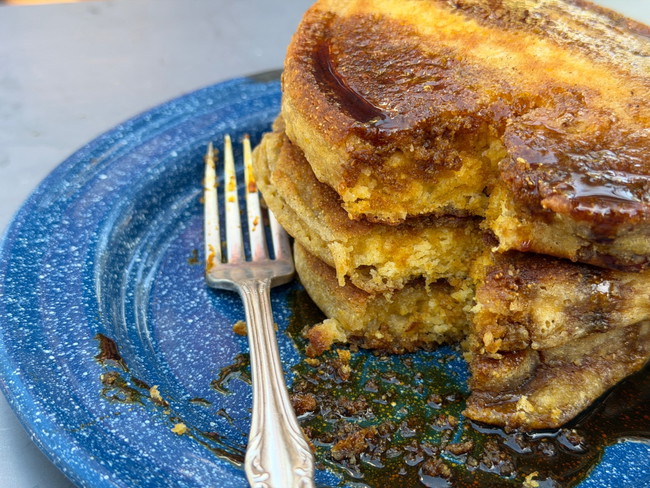
Johnny Cakes
When folks think about breakfast today, they usually picture pancakes, waffles, biscuits, or maybe a plate full of bacon and eggs. But long before any of those became common, there was a humble little cornmeal cake that helped feed a growing nation.
As we begin our America 250 series celebrating the upcoming 250th birthday of the United States, I thought there was no better place to start than with Johnny Cakes.
We appreciate you sharing our recipes with your friends and family!
This simple recipe predates the Declaration of Independence by decades and was already a staple food throughout the colonies long before America became a nation.
The Native American Roots of Johnny Cakes
The story of Johnny Cakes starts long before colonial settlements. Native American tribes had been cultivating corn for thousands of years and had invented and mastered how to grind it into meal that could be used in countless ways. They made breads, porridges, cakes, and even beverages from corn.
When European settlers arrived, they attempted to grow wheat, but many struggled. Corn proved to be far more reliable, and Native Americans shared both their knowledge and techniques.
Many historians believe the Shawnee people played an important role in the development of what eventually became known as Johnny Cakes.
Tip: The coarser the cornmeal, the better the texture. If you can find coarse-ground cornmeal, you'll get a more authentic Johnny Cake.
A Breakfast for Hard Times
One reason Johnny Cakes became so popular was because they required only a few ingredients. Originally, they were made with little more than cornmeal, water, and salt.
That simplicity made them ideal for travelers, settlers, and soldiers. The ingredients were easy to transport and could be cooked almost anywhere.
By the time of the Revolutionary War, Johnny Cakes had become a common food throughout the colonies.
Valley Forge and the Revolutionary War
During the brutal winter of 1777 at Valley Forge, thousands of Continental soldiers endured freezing temperatures, disease, and hunger.
While British troops enjoyed warm quarters and full meals in nearby Philadelphia, many American soldiers survived on simple foods cooked over open fires.
Cornmeal cakes were one of the most dependable foods available.
Whether they were called Johnny Cakes, Journey Cakes, or Hoe Cakes, these little cakes helped sustain the men who would eventually fight for American independence.
Tip: Keep your batter thicker than pancake batter. It should resemble cake batter so it holds together while cooking.
Cooking Johnny Cakes
Historically, these cakes were often cooked directly on flat stones, cast iron, or even the flat blade of a farming hoe. That is actually where the name "Hoe Cakes" comes from.
Today, a cast iron skillet works perfectly.
A little bacon grease and butter create a crispy golden crust that might just be my favorite part of the entire recipe.
As the cakes cook, watch for bubbles forming around the edges just like pancakes.
Once the bottom develops a rich golden-brown crust, flip them and finish cooking until the center is done.
Serve with molasses, honey, maple syrup, or fresh fruit.
Tip: Cook Johnny Cakes over medium-low heat. If the heat is too high, they'll brown beautifully on the outside while remaining raw in the center.
Celebrating America's 250th Birthday
What I love most about Johnny Cakes isn't just the flavor. It's the history.
This recipe connects us to Native American traditions, colonial settlements, Revolutionary War soldiers, and generations of Americans who came before us.
Sometimes the simplest recipes tell the greatest stories.
As we continue our America 250 series over the next several weeks, we'll keep exploring the foods, traditions, and people who helped build this country.

As always, thank you for watching our videos and visiting our website. Please subscribe to our YouTube Channel and like and share the videos you enjoy. We release a new video every Wednesday at 2:30! Until next time, when we see y’all out on the cowboy cooking trail.