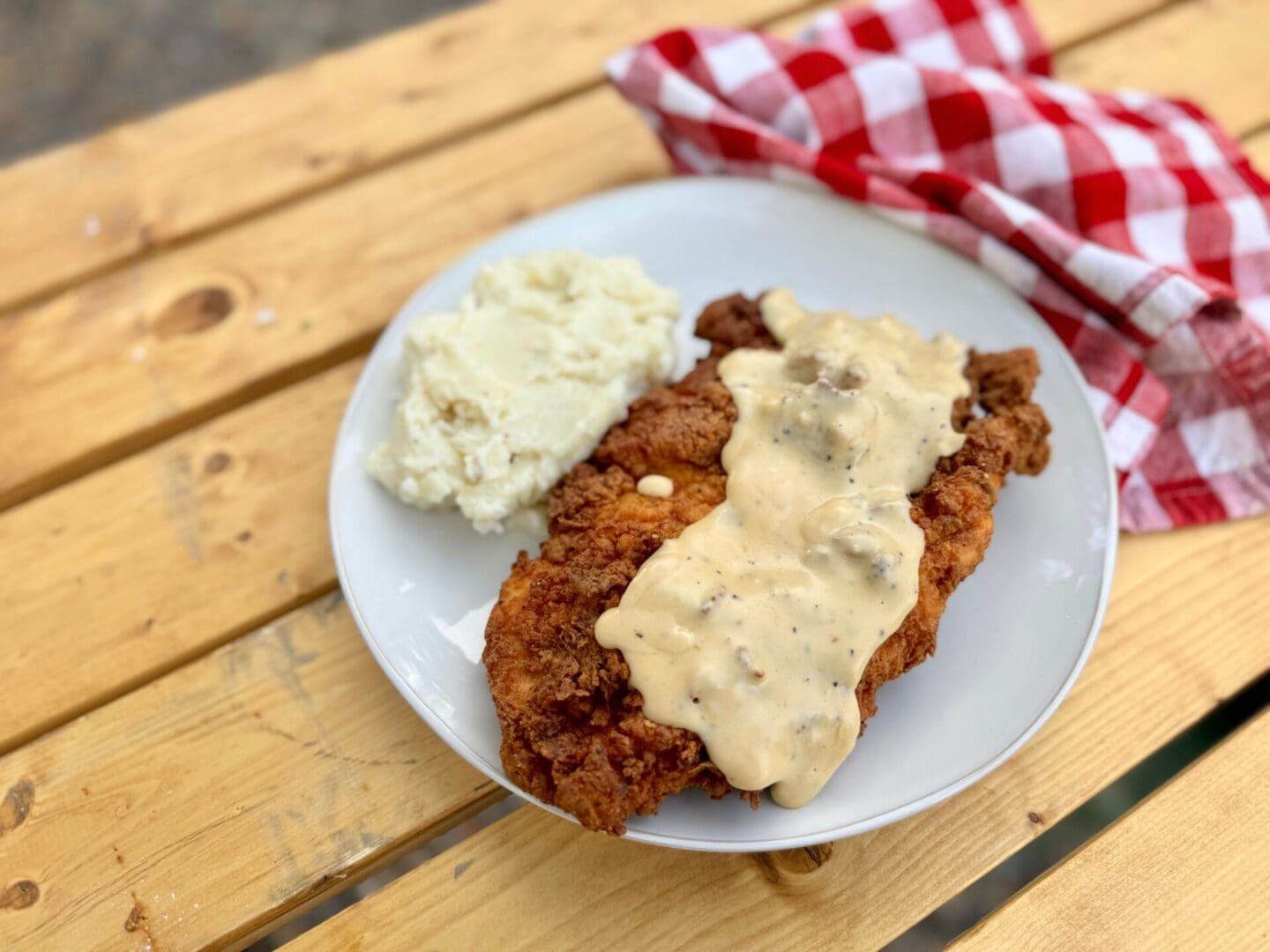
Chicken Fried Chicken
Is your homemade chicken fried chicken soggy? Does the crust fall apart or get mushy? If so, you've come to the right place. And if you have never tried to make chicken fried chicken before, now is your time. My recipe and cooking methods for making chicken fried steak beat Bobby Flay, and now I'm going to use the same method on some chicken.
The Best Chicken Fried Chicken Batter
To deep fry chicken, you need to have two bowls. One bowl will have the dry ingredients, and the other will have the wet ingredients. You batter the chicken by dipping it back and forth between these wet and dry ingredients.
This method is what I call "double-baptizing" because I dredge the chicken through the flour and the egg mixture at least two times each. This makes a thicker, crispier crust. This method also gives more flavor and aids in cooking the chicken perfectly.
We appreciate you sharing our recipes with your friends and family!
The dry mixture is made of all-purpose flour, baking powder, corn starch (for thickness), and Original Seasoning. Taste a bit of the powder and decide if it needs more seasoning or not.
Now available with Reduced Sodium!
Add More Flavor With Original Seasoning!
For the wet mixture, start with half and half. Add a little corn starch and baking powder to the half and half. Add the eggs and whisk smooth.
Preparing the Chicken for Dredging
The two most important elements of cooking chicken fried chicken is the crust, and the preparation of the chicken itself. The meat must be prepared correctly for this to turn out the way you want. You can't just deep fry a chicken breast straight from the chicken (or the package) because the outside will burn and the inside will be raw. That's why you want to pound it flat across with a mallet or a rolling pin until it's uniformly thick. If it's as wide as a dinner plate and an inch thick, you're good to go.
Tip: Cover the chicken with saran wrap when flattening so the chicken won't stick to the mallet.
After pounding the chicken flat, you'll want to tenderize the meat a little more using the 'tenderizer' side of the mallet.
When the meat is flat and even, you can cut it in half, getting two servings per chicken breast. Or, you can do what I do, which is fry 'em up whole.
Double-Baptize the Chicken
Start by dipping the chicken in the flour mixture. Make sure the chicken is well covered all over. Remove from the flour and shake off the excess. Now, do the same with the wet mixture. Get the chicken covered all over with the wet mixture, then repeat the entire process. Dry, wet, dry, wet, dry.
Now, mix half of the wet mixture into the dry mixture. Mix it just a little, until the mixture gets sticky. Then dip the chicken back in, and get some of the half wet/half dry batter to stick to it. These will form delicious crispy bites of crust after frying.
Gently set on a wire rack for a few moments to allow the batter to adhere to the chicken (the corn starch we used in the dry mixture helps with that!)
Deep Frying Chicken Fried Chicken
First, start by pre-heating the right amount of grease. You want the pot to be full enough that the chicken will be completely covered with oil, but not so much that the chicken will cause the oil to overflow.
Bring the oil to 350 degrees. Gently pick up the chicken with a pair of tongs and set it into the oil. It should immediately begin to bubble and start to cook. The chicken will cause the temperature of the oil to reduce, so keep an eye on it and turn up the heat if you need to get it back to 350.
When the crust is a deep golden brown and the internal temperature is 165, you're ready to eat. Oh, wait! No you aren't. You need some country gravy to go with that chicken fried chicken.

Country Gravy
White gravy, or 'country gravy' as some call it, is made with the drippings or grease from the fried chicken. You can use the drippings from the chicken, or you can use bacon grease. Both will be delicious!
Strain the grease into a hot cast iron skillet. Add about four tablespoons of the flour and start to stir with a flat spatula that has holes (this will help work out the lumps). You have made a roux! Congratulations!
When the roux starts to get too thick, add some of the canned milk. Stir quickly and continuously until the gravy is smooth and bubbling from heat. Do not stop stirring! Add the coarse ground black pepper and original seasoning and continue to stir.
Tip: If your gravy is too thick, cut it with a couple of tablespoons of canned milk or cold water.
To thicken the gravy if it is too thin, stir together equal parts of corn starch and cold water, then whisk into the skillet. This will automatically cause the gravy to thicken.
Serve with mashed potatoes and biscuits. Just look at this beautiful crust. The picture speaks for itself.

As always, Shannon and I thank you for visiting. Don’t forget to subscribe to the YouTube channel and the e-mail newsletter. Please follow us on Facebook and Instagram!